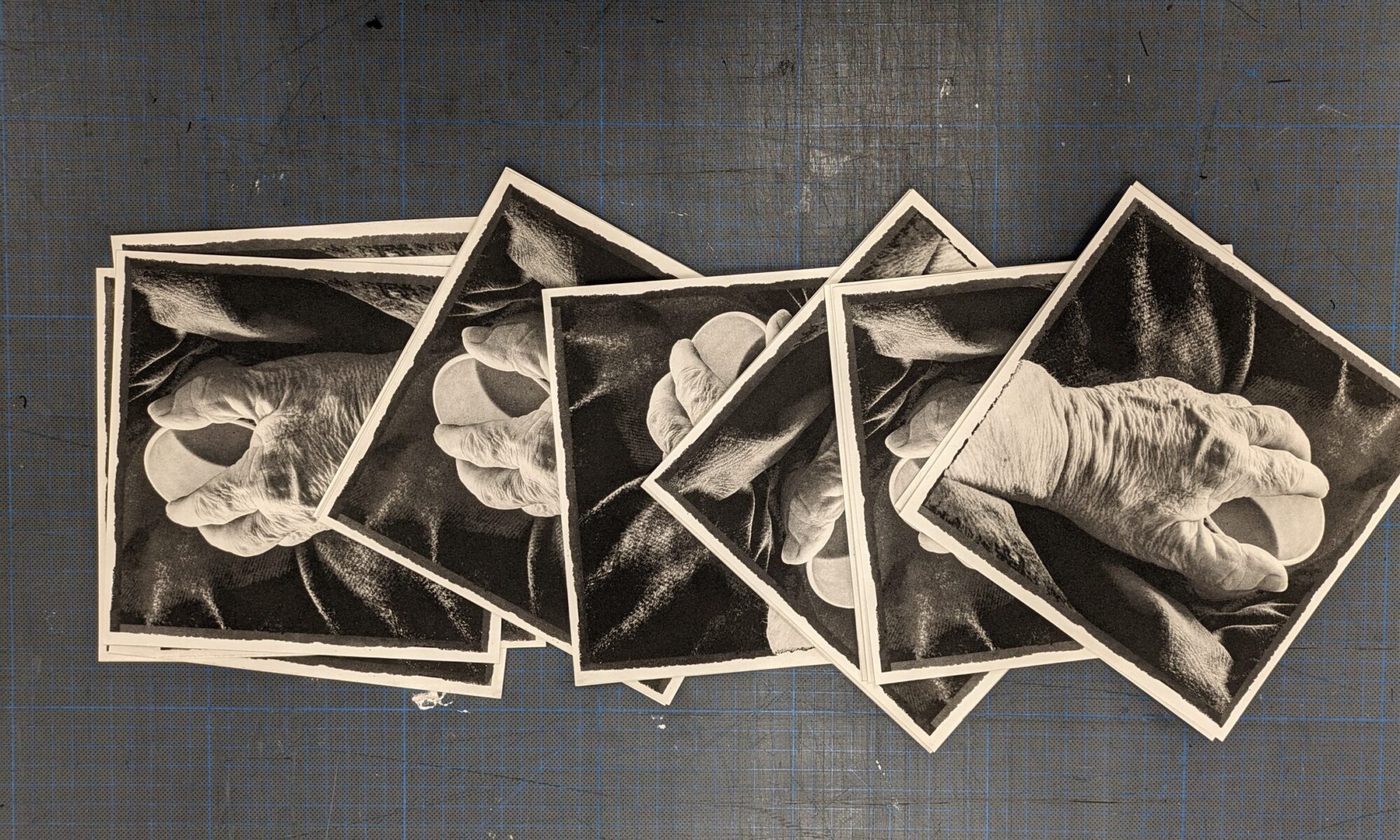
There’s much more to be done in assessing the variables that can applied to to screen print techniques, applications, drawing, drawing materials, emulsions, exposure etc however this has been a valuable first period to lay foundations for further research in technical, artistic and conceptual approaches in the pursuit of contemporary poraiture in digital and analogue parameters of image making in fine art printmaking.

This research into fine detail silkscreen print began with the print of Artist Photographer Paul Kenny: ‘Paul Explains’
For this print the drawing was on smooth mark resist, printed through a 165 screen mesh with regular Z1 emulsion, coated once on the positive side. It certainly worked for me in that the drawing captured the animation and expression of Paul in full flow in his home in Northumberland near his beloved sea coast. The variety of textures also worked to reflect Paul’s character, his choice of warm garments and his animated gesticulation when discussing contemporary art and photography. Reviewing the print I felt that a finer detailed print might reduce the contrast of the image and that further extending the variety of facial and bodily tones would enhance the portrait.

Having introduced and tested the fine mesh and emulsion tests with ‘Katie B and Cousin’ and ‘Sharing Print Insights, Elaine Shemilt’ I returned to Paul and two more drawings printed with the new found and tested fine detail materials. Both portraits are drawn on mark resist with graphite pencil. Drawing two more portraits of Paul also gave the opportunity to test the concept that three might be better than one, to reflect the wealth and warmth of Paul’s character. I had smart phone photographed Paul on a number of occasions and putting all the images together as if on a photographic contact strip allowed me to see how a number of images could be selected to give a fuller picture of the man, rather than a single image.
The single all encompassing image is the tradition of portrait painting and photography and artists from time to time have tried to make multi images of a subject in one frame. These approaches are admirable, however many subjects have a wide rage of elements to their character and strings to their individual bows. So three portraits of Paul may give a more insightful representation. Applying this approach brings conceptual element into the technical research to date.
The first : ‘Cheswick Beach Explanations’ with only graphite pencils.
Whereas the first print began as a picture in the subject’s home following a long walk on the sea coast this picture was selected from a number, made on the walk. Paul had added to his apparell with his cap, scarf, waterproof coat and a small sr camera. Paul is a brilliant photographic image making artist using mesmerising, detailed and time consuming and methods to create his images using analogue and digital techniques in his darkrooom/studio. His SLR is more for personal and non artistic use, so to include it in the portrait is a play on his artist practice – i.e. he will invariably never create his art with this camera, but here he has it slung around his neck as if a ‘photographer’. Paul and I were both taught by Geoff Lowe at Newcastle Poly fine art department. I remember Geoff saying in one of his passing remarks that cameras are like male jewelery. This stuck with me as a comment on the camera as male appendage way back then in the early 70’s, (nineteen seventies) while I was tussling with images and art created through photography, print, film, book and poster making in the time of ‘conceptual art’. 40 Years on Paul and I have met again through the ubiquitous democracy of social media that has connected us through the internet which had only been a glint in Sir Tim Berners Lee’s eye back then. Photography was analogue, video was just becoming available and our current digital world of technology and communications was only being researched and investigated by scientists. What of Printmaking and Drawing then and now?
This print is using a 180 silk screen mesh, coated once on the print and once on the positive side, dried and exposed for 8 light units. Washed out, dried, stopped out and printed with 3 parts pigment, 3 parts extender and 3 parts retarder. Pigment was composed of 1 part Lascaux indigo and 2 parts system black. Prints were made on Canaletto cotton paper and 3 on Fabrianno Rosapina rag paper.


The final print was flooded 6 times and ‘pulled’ once to provide a full inked crisp image with a good range from blacks to whites, shadows to highlights.
The second portrait print ‘Paul Listens and Holds Millie’ was drawn with graphite pencils from HB to 9B on mark resist to assess the different drawing qualities achievable for the range of textures from human to canine, wool to leather.


This print using the 180 mesh screen, Z133 emulsion, coated on both sides and exposed for 8 light units confirms these settings are perfect for drawings using graphite pencils on mark resist. The head was drawn with HB and has printed retaining the soft, low contrast drawing.
The print on Canaletto is higher contrast on the ‘flat’ white cotton paper than the softer print on the Fabriano course rag paper. The ink was thickened up with additional pigment 2 parts system black and 1 part indigo Lascaux. The squeegee angle was also increased and thereby increased the pull pressure. The screen was flooded 4 times and two pulls were applied.
This research period has been dedicated to testing and analysing silk screen techniques that can be applied to create fine art prints that capture and reflect people I have engaged with in their varied artistic roles. The understanding of the silk screen medium and the variety of materials and techniques that can be selected enables artistic choices to be made in respect of new subjects to be drawn from smart phone images as I pursue the next phase of portraiture in the digital and analogue environments. The drawings are made pre print and are being extended with greater precision garnered from this research. This allows technical and artistic decisions to be made when interpreting the subject.
Below are the finished prints.


Slide show
[foogallery id=”1718″]
Next variables to be tested in this research will be different drawing films (e.g. true Grain and Digital transparency) and then a range of papers beyond the 4 papers used to date :Fabrianno Rosapina, Tieplo, Cannaletto, cartridge, Somerset Tub.